Why Wine Cellar Cooling Failures in Scottsdale Are More Common Than Owners Expect
Wine does not forgive temperature swings. Scottsdale owners learn that the hard way when a cellar creeps past 60 degrees in July and stays there. This market sees a higher rate of wine cellar cooling failures than many expect, even in luxury builds north of Loop 101. The reason is a mix of hot-dry climate physics, equipment selection that was made for a basement in Oregon, and installation shortcuts that ignore what 115-degree days do to small refrigeration systems. Day and Night Air Conditioning, Heating and Plumbing sees these calls often across North Scottsdale, DC Ranch, Troon, Grayhawk, and Old Town Scottsdale zip codes 85251 and 85255. The patterns are repeatable, preventable, and fixable with the right approach from a contractor who works AC services in Scottsdale every summer and knows how residential and light commercial refrigeration behave at ASHRAE 169 climate zone 2B conditions.
Why Scottsdale Wine Cellar Cooling Struggles More Than Owners Expect
Most off-the-shelf wine cooling units, including through-the-wall and small ducted systems, are engineered for ambient spaces in the 75 to 85 degree range. In Scottsdale, the real ambient around the condenser side is often far hotter. Homebuilders and remodelers place condensers in west-facing garages, mechanical closets with no ventilation, or attic spaces that sit at 130 to 150 degrees in July. At those temperatures, the condenser coil, which is the outdoor heat exchanger that must reject heat to the surrounding air, cannot throw off enough heat. Head pressure climbs, compressors overheat, and the wine side of the system drifts out of its 55-degree setpoint at 60 to 65 percent relative humidity. That is the most common failure pattern Day and Night finds in Scottsdale wine rooms that were built without local HVAC oversight.
There is a second Scottsdale-specific pressure: the monsoon season. From June through September, haboob dust events pack condenser coils with caliche fines. Caliche is the fine, cement-like desert dust that plugs coil fins. On small wine cooling condensers with limited surface area, that fouling can drop capacity by 15 to 25 percent until the fins are cleaned. Day and Night has documented that loss across dozens of service calls each summer in 85254, 85255, and 85260. Owners who never had a professional clean the condenser since installation usually call after the second or third monsoon storm of the season.
Ambient placement and coil fouling are not the only culprits. The next group of failures comes from loads that were never calculated. Builders size cellar units by cubic feet without modeling infiltration, glass area, insulation level, door leakage, or Scottsdale solar gain hitting the adjacent walls. That is why a 1,200-bottle room in McCormick Ranch with two glass walls can need double the cooling capacity of the same footprint room in a shaded McDowell Mountain Ranch home with full vapor barrier and proper insulation. Wine cellars need a true load calculation. In Scottsdale, that means a Manual J methodology adapted to a setpoint near 55 degrees and a higher latent load for humidity stability. Sizing by square footage is what drives constant run time, ice-up of the evaporator coil, short cycling in spring and fall, and early compressor failure.
What Fails Inside a Scottsdale Wine Cellar Cooling System
Wine cooling systems are refrigeration systems. They share parts with standard AC equipment, only smaller. When Scottsdale heat punishes these components, they fail the same way big residential systems do, but faster because margins are tighter.
The compressor is the motor at the heart of the system that pumps refrigerant. When the condensing space is too hot, the compressor runs near its maximum discharge temperature. Thermal overload trips shut it down. Repeated trips wear windings and shorten life. The run capacitor, which is the cylindrical electrical component that stores and releases an energy pulse to start the compressor and fan motors, is also vulnerable. At Scottsdale pad or attic temperatures above 130 degrees, capacitors drift out of tolerance or fail outright. Day and Night sees a spike in run capacitor failure starting in late June in areas around Camelback Mountain and along Loop 101 because those condensers sit in west-facing utility rooms or garages that never cool down overnight.
Contactor points, which are the switch contacts that pull in to send power to the compressor and fan, pit and burn from high-current starts. When contactors weld shut, the unit will not shut off. When they pit, the compressor chatters or fails to start. Refrigerant charge issues also appear often. Low charge from a micro-leak at the TXV valve, which is the thermostatic expansion valve that meters refrigerant into the evaporator coil, or ac services at an evaporator coil braze joint will cause the coil to ice. On the wine side, that shows up as a slow warm-up and a block of ice behind the grille. On the condenser side, clogged fins from dust and pet hair force head pressure higher, which pushes refrigerant oil out of the compressor and into lines. Over time, the compressor runs dry and fails. Each of these failures is common across Scottsdale and Paradise Valley wine rooms that were never put on a maintenance plan.
Humidity Control Is Not Optional in Scottsdale
Wine wants stable humidity. Most labels and corks handle 60 to 65 percent relative humidity. In Scottsdale’s hot-dry climate, the natural state of the room without vapor barrier and humidification is 10 to 30 percent. Many wine cooling units will hold temperature but ac service cannot add moisture. That leads to shrinkage at corks and label curl. During monsoon season, the outdoor humidity jumps, but the room still swings because the cooling system short cycles if it was oversized. That short cycling removes less moisture per hour. Flask by flask, the cellar drifts out of spec. Day and Night’s technicians look at humidity swings first when an owner reports a room that will not settle. If the wine side evaporator coil is oversized compared to the actual sensible and latent load of the room, the system drops temperature rapidly and shuts off before it can stabilize humidity. The remedy is right-sizing and sometimes moving to a ducted split with variable speed so the system can run long, slow cycles that hold both temperature and humidity.
Why Refrigerant Type Matters in 2026 and Beyond
There is a refrigerant change coming to the entire AC market that touches wine rooms as well. The federal transition to refrigerant R-454B under EPA SNAP Rule 24 takes effect on January 1, 2026. That rule ends new manufacturing of R-410A equipment going forward. R-454B is an A2L refrigerant, which means it is mildly flammable and requires updated technician certification, leak detection, and specific installation clearances and ventilation in certain applications. It also has a much lower global warming potential than R-410A. Scottsdale homeowners with wine cooling systems that use R-410A can still service those systems, but supply of new R-410A will tighten over the next several years. For owners approaching a replacement or an upgrade to a ducted split, this timing matters. It can affect equipment selection and the availability of parts. Day and Night technicians are EPA Section 608 certified and trained on R-454B service procedures. That matters in Scottsdale wine rooms tucked into closets and under stairs where concentration thresholds and ventilation must be considered if an A2L refrigerant is involved.
Cellar Construction Decisions That Make or Break System Performance
Cooling equipment gets far too much blame in Scottsdale. The enclosure is usually the real problem. A high-performance wine room in Maricopa County needs a full vapor barrier on the warm side of the wall assembly. That means a continuous, sealed poly or equivalent barrier behind the drywall or finish, with all seams taped and penetrations sealed. It also needs high R-value insulation on walls and ceiling. Most luxury rooms Day and Night evaluates in 85255 and 85259 have gorgeous glass doors with no seals and stud bays with missing insulation. As a result, infiltration, which is the unplanned air exchange from gaps and leaks, loads the system with hot, dry air all day. The equipment runs without stopping and still fails to hold 55 degrees at 60 to 65 percent humidity.
Glass is another Scottsdale trap. South and west exposures along Bell Road, Greenway Road, and in Old Town Scottsdale collect intense solar gain. A full glass wall throws the Manual J load calculation off by thousands of BTUs if the glass type, shading, and orientation are not modeled. That is why a cellar under a staircase on a shaded north wall holds like a rock with a small ducted split, while a pretty glass showpiece off the great room fails with a unit that looks oversized on paper. In wine rooms, the building envelope sets the ceiling for what any AC services in Scottsdale can deliver after the fact. Fixes are still possible, but honest discussion about door seals, insulated walls, and UV coatings on glass is part of a real solution.
Common Owner Setups That Drive Failure in Scottsdale Homes
Three Scottsdale patterns repeat. These are the ones technicians see weekly in North Scottsdale, Gainey Ranch, McCormick Ranch, and DC Ranch.
- Condenser in a closed garage or attic with no ventilation. Attic air at 140 degrees starves the condenser coil. The compressor hits thermal overload and fails early. Through-the-wall unit in a pantry with no path for exhaust air to leave. The unit reheats its own exhaust air. Performance drops every hour it runs. Ductless mini-split added to the wine room to “help” a failing unit. The mini-split drops air temperature but dries the room to 30 percent. Corks pay the price.
The quick diagnostic sign is simple. If the condenser air feels hotter than a Phoenix summer parking lot and there is nowhere for that hot air to go, expect failure. Day and Night relocates many Scottsdale condensers outdoors in shaded areas or adds louvered ventilation and powered exhaust to mechanical closets on projects along the Pima Road corridor near Loop 101.
How Day and Night Diagnoses Wine Cellar Cooling Failures
Service starts with the basics that apply to every AC diagnostic across Maricopa County, adapted to small refrigeration systems.
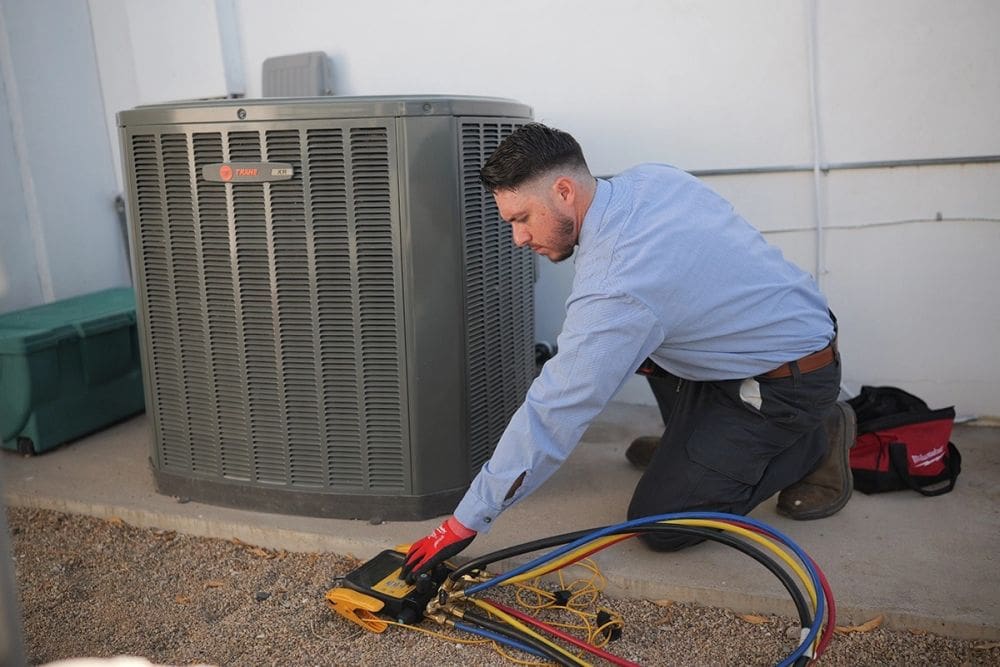
Technicians start with airflow and coil surface condition. They remove grills and check the evaporator coil, which is the cold indoor coil that removes heat and moisture from the cellar air. If it is matted with dust or iced over, they thaw it and clean it. On the condenser side, they wash the condenser coil with a cleaner that does not attack fins, and they straighten fins if they are crushed. In Scottsdale during monsoon season, this step alone often restores 15 to 25 percent of lost capacity.
Next, they test the electrical path. A capacitance meter checks the run capacitor and any start capacitor against nameplate values. If it is out of tolerance, they replace it. They inspect the contactor for pitting or welding. They verify the wine controller or thermostat is calibrated and reading actual room conditions. If the cellar uses a separate humidistat, they test its function and placement. Sensors installed near a supply register will read wrong and drive erratic control.
Then they verify refrigerant charge. On systems with service ports, they measure superheat and subcooling. Superheat is the temperature of the refrigerant vapor above its boiling point at the evaporator outlet, which tells a technician whether the evaporator is being fed properly. Subcooling is the temperature of the refrigerant liquid below its condensing temperature at the condenser outlet, which shows whether the condenser is rejecting enough heat and if the metering device is stable. On sealed systems without ports, they use temperature splits, line temperatures, and amp draws to infer charge condition and metering behavior. Low refrigerant charge points to a leak, often at the TXV or a braze joint. They do not “top off” a leaking system in Scottsdale. They find and fix the leak.
Finally, they assess the enclosure. They run a smoke pencil at door seals and penetrations. They scan for missing vapor barrier with an infrared camera on exterior walls during the afternoon when the solar load is highest. If an owner is open to correction, the technician documents insulation and sealing improvements that will stabilize the room and reduce equipment stress. This work has more impact on wine preservation than any brand changeout ever will.
Split, Ducted, or Through-the-Wall: What Works in Scottsdale
Through-the-wall units are common in quick builds. They are easiest to install and cheapest up front. In Scottsdale, they often struggle to reject heat because the exhaust air is dumped into a small pantry or hallway that soon heats up. That is why many through-the-wall systems in 85251 and 85259 homes last only a few years. If the owner wants reliability and better humidity control, a ducted split is usually the answer. A split system puts the evaporator in or near the wine room and the condenser outdoors where it can breathe. Ducts move air quietly. Variable speed fans run long and slow to hold humidity. The condenser can sit on a shaded pad on the north side of the home, which can be 20 to 30 degrees cooler than a garage or attic. Day and Night installs and services both types, but in Scottsdale’s climate, splits with proper placement win on stability and service life.
Why Scottsdale’s Hot-Dry Climate Exposes Design Shortcuts
Maricopa County sits at 1,086 feet elevation and carries an ASHRAE 99 percent percentile design cooling temperature that ranges from 110 to 117 degrees depending on neighborhood elevation and exposure. In that environment, residential AC units on west-exposure pads see ambient temperatures of 130 to 140 degrees in the late afternoon. That reality is why run capacitors fail across Phoenix zip codes 85016 and 85018 every June and July. The same physics crush wine cellar cooling systems not designed for those ambients. The condenser cannot reject heat, refrigerant pressures soar, oil migrates, and the compressor runs out of lubrication. Scottsdale owners who assume a wine unit rated at 3,000 BTU will deliver that number no matter the garage or attic temperature end up with spoiled wine. Ratings are measured at defined ambient conditions. Scottsdale rarely delivers those conditions at the condenser side unless the unit is outdoors in shade or a ventilated mechanical room.
The R-410A to R-454B Transition and What It Means for Wine Room Projects
As the market moves into 2026, new AC equipment production shifts to A2L refrigerants such as R-454B. For wine rooms, this change means a few practical steps. Technicians who install or service these systems need updated training, A2L-rated leak detectors, and an understanding of maximum refrigerant concentration limits in small rooms. It also changes owner choices on replacement. An R-410A split unit installed in 2018 might still have service life left, but if it leaks or loses a compressor in 2026 or 2027, repair economics will look different as R-410A supply tightens. Scottsdale owners planning a whole home AC replacement in Arcadia or Biltmore who also want to correct a wine room often ask whether to tie projects together. Day and Night’s team walks through Manual J load for the home, Manual S equipment selection, and Manual D for duct design, and then sets the wine room on its own dedicated split so its setpoint and humidity control are independent. Owners who add a small dedicated variable-speed heat pump or mini-split to temper an adjacent buffer space sometimes qualify for APS Cool Rewards heat pump rebates up to $2,000, SRP HVAC rebates up to $1,500, and the federal Inflation Reduction Act Section 25C heat pump credit up to $2,000. While wine cooling equipment itself is not typically rebate-eligible, Scottsdale owners often stack incentives when they address the surrounding space with high-efficiency equipment in the same project window.
Maintenance Done the Scottsdale Way
Wine cooling maintenance in Scottsdale is not a “once a year and forget it” item. The desert adds dust, heat, and swings in outdoor humidity from monsoon storms that no brochure mentions. Day and Night sets wine rooms on a service rhythm that matches local stress. Monsoon season calls for condenser coil cleaning after each major dust event to recover the 15 to 25 percent capacity that fouling steals. Electrical testing of run capacitors and contactors before the first 110-degree week avoids nuisance failures. Evaporator coil cleaning and drain pan checks prevent algae from clogging the condensate drain line, which is the pipe that removes water that the evaporator pulls out of the air. A clogged drain trips safety switches and shuts units down on holiday weekends. Technicians also verify that the room’s humidity sensor reads in the body of the room, not in a supply air stream. If a humidifier is present, it is serviced with the same rigor used for hard-water Phoenix homes because CAP water hardness at 12 to 18 grains per gallon will scale humidifier pads quickly.
What a Full Diagnostic Report Looks Like
Owners who invest in wine expect documentation. After a Day and Night diagnostic in Scottsdale, the report lists observed room temperature and humidity, controller setpoints, and sensor placement. It includes superheat and subcooling readings, compressor amp draw versus rated values, run capacitor microfarad readings and tolerance pass or fail, contactor condition, coil cleanliness, and airflow checks. It documents refrigerant type, line set lengths where visible, and any attic or garage ambient readings near the condenser. It also includes enclosure findings with photos of door seals, missing vapor barrier signs, and insulation voids. The final section outlines corrections in order of priority, from airflow and cleaning to component replacement, leak repair, or equipment relocation. If replacement is recommended, the report explains why and what a Scottsdale-appropriate installation would change, including condenser placement outdoors in shade and a Manual J-based sizing review of the room.
Red Flags Scottsdale Owners Should Not Ignore
- Wine room temperature that rises above 60 degrees for more than a few hours in July or August. Visible frost or ice on the evaporator grille, or water on the floor from a thaw cycle. Unit that never shuts off, or short cycles every few minutes during monsoon season. Humidity readings that swing 20 points during a 24-hour period. Condenser located in an attic or closed garage with no visible ventilation or louvered doors.
Each of these signs is common in Scottsdale and Paradise Valley. Each points to a short list of causes that an experienced technician can diagnose quickly. Owners who call early protect their collection and usually avoid compressor damage. This is where working with a team that handles AC services in Scottsdale daily matters. They know where to look and what local conditions will do to small refrigeration systems.
Scottsdale Details That Matter on Replacement or Relocation
When replacement is the right call, the Scottsdale plan includes the following. Place the condenser outdoors on the north or east side when possible, away from direct sun and walls that trap hot air. Verify setback and HOA rules, which are common in North Scottsdale communities like DC Ranch and Troon. If outdoors is impossible, build a mechanical closet with louvered doors and a powered exhaust fan that vents to the outside. Do not vent to the attic or garage. Run refrigerant line sets in insulated chases to avoid heat gain. Use a dedicated electrical circuit sized for the unit with a lockable disconnect, per code. Seal all wall penetrations airtight to maintain the cellar vapor barrier. If the room uses glass, use insulated, low-E glass and seal the door with proper gaskets. Size the equipment with a Manual J-style approach, not by cubic feet alone. In Scottsdale, that calculation must include glass solar gain and infiltration at 110 to 117 degree outdoor design temperatures.
Why a Phoenix-Based Contractor Helps Scottsdale Owners
Wine cellar work in Scottsdale benefits from field time across the full Phoenix metro. Day and Night has worked 47+ years across Maricopa County from the headquarters at 3669 E La Salle St in the 85040 corridor near Phoenix Sky Harbor Airport. The team has solved cooling failures in Arcadia, Biltmore, Desert Ridge, Sunnyslope, Maryvale, Camelback East, and Paradise Valley Village, and has seen the same failure modes repeat in Scottsdale with slightly different envelopes and HOA rules. That matters when a failed wine unit sits next to a whole home air handler, a tankless water heater, and a softener loop, and each service intersects. Day and Night holds Arizona ROC C-39 Air Conditioning and Refrigeration and ROC C-37 Plumbing licenses, which means one team can move a condenser, add a code-compliant condensate drain with a proper trap, relocate electrical, and correct humidifier plumbing without three subcontractors and a month of delays.
What Makes This a Shareable Scottsdale HVAC Fact
The single most surprising performance note for wine owners and Realtors on the Scottsdale beat is this. During monsoon season, small condensers serving wine rooms lose 15 to 25 percent of cooling capacity from caliche dust clogging fins after just one dust storm. Many owners do not notice until the second storm when the unit begins to run non-stop. Better yet, move the condenser outdoors in shade and schedule a coil rinse after each significant dust event from June through September. That change alone prevents a large share of cellar failures reported in 85251, 85254, 85255, 85258, 85259, and 85260.
Serving Scottsdale and the Greater Phoenix Area
Scottsdale projects often involve coordination across city lines, especially when owners split time between homes. Day and Night runs AC services in Scottsdale and throughout Maricopa County, including Phoenix neighborhoods along the Camelback Corridor and Arcadia, the Ahwatukee Foothills zip codes 85044 and 85048, Desert Ridge at 85050 and 85054, and North Phoenix along I-17 and the SR 51 corridor. Crews also support Tempe, Mesa, Chandler, and Gilbert when a home sale depends on a working wine cellar. The dispatch center sits close to Loop 202 and I-10, which speeds response during summer heat or a weekend monsoon outage.
Cost, Timing, and 2026 Planning
Wine cellar repair costs in Scottsdale vary by failure. Electrical component repairs such as run capacitors and contactors tend to be smaller jobs with fast turnarounds. Coil cleaning and airflow corrections are similar. Leak repair and compressor replacement carry more cost and downtime. Relocations and split conversions involve planning, HOA approvals in some neighborhoods, and permitting. As 2026 approaches, Scottsdale owners should expect R-454B-based equipment to become the norm for many split systems. That means selecting installers trained for A2L refrigerant handling and planning mechanical room ventilation correctly. It also means owners replacing or adding high-efficiency equipment to condition adjacent spaces can look at APS Cool Rewards up to $2,000, SRP HVAC rebates up to $1,500, and federal Section 25C heat pump credits up to $2,000. These incentives do not usually apply to wine equipment directly but can offset project budgets when owners improve the surrounding spaces to stabilize the cellar’s environment.
Why Immediate Action Matters in July and August
A few hours at 70 degrees will not ruin a collection. Days at 70 will. July and August do not offer much slack in Scottsdale. West-exposure rooms overheat late in the day. Attic spaces push condensers into thermal overload. Monsoon outages and power blips can lock out controllers until someone resets the system. If a wine room sits at 65 degrees and climbing, that is the time to call a contractor who works AC services in Scottsdale every day and can dispatch the same day, even at night. The right technician can usually stabilize the room on the first visit and then plan long-term corrections once the collection is safe.
What to Expect from a Local Scottsdale-Focused Team
Owners should look for a few basics. Ask for a written diagnostic price before work begins. Expect a full explanation of findings in plain English. Request before and after coil photos. Ask for run capacitor readings and a pass or fail statement. Expect a refrigerant type notation and a comment on how the 2026 R-454B transition might affect future service. Ask whether the condenser location is viable at Scottsdale ambients. Expect someone to look at the room’s door seals and insulation. If a team is not willing to talk about the envelope, they are not solving your actual problem. Scottsdale homes deserve better than a band-aid service call when wine is at stake.
Why Scottsdale Restaurants and Small Retail Cellars See the Same Failures
Small commercial wine rooms along Scottsdale Road and in Old Town Scottsdale see the same issues as homes, with one twist. Restaurants often stack equipment in shared mechanical rooms. Heat load there can push past residential levels. A condenser that rejects heat into a room that also houses a walk-in cooler and a rooftop package unit return plenum is sitting in a hot bath. Without dedicated ventilation, wine cooling fails on the first 115-degree day. Commercial operators should treat these spaces like a mini data center. Provide intake air, use a thermostatically controlled exhaust, and keep filters clean. Day and Night’s commercial HVAC team works rooftop packaged units and small refrigeration every day across Camelback East, Encanto, and the Scottsdale Waterfront area, and brings that same knowledge to restaurant wine rooms.
Final Word for Scottsdale Wine Owners and Managers
Wine cellar cooling in Scottsdale fails more often than it should, but the causes are simple when viewed through a Phoenix lens. Ambient heat where the condenser sits, monsoon dust that strangles coils, missing vapor barriers, oversized coils that short cycle during monsoon humidity, and equipment selected for milder climates. Each is solvable. The contractor who handles AC services in Scottsdale and across Phoenix zip codes daily will fix the root, not just the symptom. That is how a 55-degree room at 60 to 65 percent humidity stays that way all summer.
Call for Scottsdale Wine Cellar Cooling Service
Day and Night Air Conditioning, Heating and Plumbing has served Phoenix and Maricopa County since 1978 from its headquarters at 3669 E La Salle St, Phoenix, 85040. The team is Arizona ROC C-39 HVAC and ROC C-37 plumbing licensed, EPA Section 608 certified, and trained for the R-454B A2L refrigerant transition. Same-day and 24/7 emergency service is available across Scottsdale, Paradise Valley, and the entire Valley. Upfront flat-rate pricing is presented in writing before any repair begins, and free estimates are offered on new or relocated split systems. For wine cellar cooling repair, stabilization, or replacement by a contractor who delivers AC services in Scottsdale every day, call (602) 584-7758.
Day & Night Air Conditioning, Heating & Plumbing AZ Licenses: ROC335883 | ROC335884 📍 Phoenix Headquarters 3669 E La Salle St,
Phoenix, AZ 85040 📞 24/7 Service Phone (602) 584-7758 Get Directions Visit Website 📘 Facebook 📸 Instagram 💼 LinkedIn